How to Label Handmade Soap for Sale: FDA Rules You Need to Know
Learn how to label handmade soap correctly for sale in the US. Covers FDA vs CPSC rules, required label elements, INCI names, net weight, and common mistakes.
This article contains Amazon links. As an Amazon Associate, Soaply earns from qualifying purchases at no extra cost to you.
You've perfected your recipe, cured your bars, and you're ready to sell. But before a single bar leaves your hands, you need to get your labels right. Mislabeled soap can result in fines, product seizures, or forced recalls. The rules aren't complicated once you understand them, but they trip up a lot of new sellers.
- Is Your Product "Soap" or a "Cosmetic"?
- What the FDA Says About True Soap
- Required Label Elements for True Soap
- When Your Soap Becomes a Cosmetic
- INCI Names: The Ingredient Naming System
- Net Weight Rules
- Label Layout and Placement
- Common Labeling Mistakes
- Label Design Tips That Sell
- Printing Your Labels
- Frequently Asked Questions
Is Your Product "Soap" or a "Cosmetic"?
This is the single most important question for labeling. The answer determines which rules apply and how much information your label needs.
In the US, there are two regulatory paths:
| Classification | Regulated By | Label Requirements |
| --------------- | ------------- | ------------------- |
| True soap | CPSC (Consumer Product Safety Commission) | Minimal: product name, net weight, business info |
| Cosmetic | FDA (Food and Drug Administration) | Full: ingredients list, warnings, specific formatting |
Most cold process soap made from oils and lye qualifies as "true soap" under the law. That's good news because true soap has the simplest labeling requirements.
What the FDA Says About True Soap
According to the FDA, a product is "true soap" when:
- The bulk of the nonvolatile matter consists of an alkali salt of fatty acids. Translation: it's made by saponifying oils/fats with lye (NaOH or KOH).
- The detergent properties are due to the alkali-fatty acid compounds. Translation: it cleans because of saponification, not because of added synthetic detergents.
- It's labeled and sold solely as soap. Translation: you don't make drug or cosmetic claims on the label.
If your cold process soap is made from oils + lye, and you call it "soap" without claiming it treats acne, moisturizes skin, or cures anything, it's true soap.
The moment you make a claim beyond cleaning, your product may become a cosmetic or even a drug. More on that below.
Required Label Elements for True Soap
True soap regulated by the CPSC needs only three things on the label:
1. Product Identity
What the product is. This can be as simple as "Handmade Soap" or "Bar Soap."
You can also include a descriptive name like "Lavender Oatmeal Bar Soap" as long as you include the word "soap" somewhere on the front panel.
2. Net Weight
The weight of the soap bar, displayed on the bottom third of the front panel (called the Principal Display Panel or PDP).
Must be in both:
- US customary units: ounces (oz)
- Metric units: grams (g)
Example: Net Wt. 4.5 oz (128 g)
3. Business Name and Address
Your business name and a street address (PO boxes are acceptable for small businesses). This goes on any panel of the label, but most soap makers put it on the back.
That's it for true soap. You do NOT need to list ingredients. However, many soap makers choose to list them anyway because customers expect it and it builds trust.
When Your Soap Becomes a Cosmetic
Your soap crosses into cosmetic territory if you:
- Make cosmetic claims: "Moisturizing," "anti-aging," "skin-softening"
- Add synthetic detergents: Sodium lauryl sulfate, cocamidopropyl betaine
- Market it for appearance: "Makes skin glow," "reduces wrinkles"
And it becomes a drug if you claim it:
- Treats acne
- Heals eczema
- Has antibacterial properties
- Cures or prevents any medical condition
Cosmetic Label Requirements
If your product is classified as a cosmetic, you need everything true soap requires PLUS:
- Full ingredient list in descending order of predominance
- Ingredients listed by INCI names (International Nomenclature of Cosmetic Ingredients)
- Warning statements if applicable
- Specific formatting rules for text size and placement
This is why careful wording on your labels matters so much.
Safe vs Risky Label Language
| Safe (True Soap) | Risky (May Be Cosmetic) | Dangerous (May Be Drug) |
| ------------------- | ------------------------ | ------------------------ |
| "Handmade bar soap" | "Moisturizing soap" | "Acne treatment soap" |
| "Scented with lavender" | "Skin-softening formula" | "Antibacterial soap" |
| "Made with olive oil" | "Anti-aging soap bar" | "Eczema relief soap" |
| "Naturally colored" | "Brightening soap" | "Medicated soap" |
Stick with the left column and you'll stay in true soap territory.
INCI Names: The Ingredient Naming System
Even though true soap doesn't require an ingredient list, most sellers include one. If you do, using INCI names looks professional and is required if your product is classified as a cosmetic.
INCI names describe the saponified product, not the raw inputs. Here's how common soap ingredients are listed:
Oils (After Saponification)
| What You Used | INCI Name |
| -------------- | ----------- |
| Olive Oil + NaOH | Sodium Olivate |
| Coconut Oil + NaOH | Sodium Cocoate |
| Palm Oil + NaOH | Sodium Palmate |
| Shea Butter + NaOH | Sodium Shea Butterate |
| Castor Oil + NaOH | Sodium Castorate |
| Lard + NaOH | Sodium Lardate |
| Tallow + NaOH | Sodium Tallowate |
Other Common Ingredients
| Ingredient | INCI Name |
| ----------- | ----------- |
| Water | Aqua |
| Sodium Hydroxide (lye) | Sodium Hydroxide |
| Fragrance Oil | Fragrance (Parfum) |
| Essential Oil | List by plant name, e.g., Lavandula Angustifolia (Lavender) Oil |
| Titanium Dioxide | Titanium Dioxide (CI 77891) |
| Activated Charcoal | Charcoal Powder |
| Kaolin Clay | Kaolin |
| Sodium Lactate | Sodium Lactate |
Listing Order
List ingredients in descending order of predominance (by weight at the time of manufacture). For soap, this typically goes:
- Saponified oils (by percentage in recipe)
- Aqua (water)
- Sodium Hydroxide (if any remains, though in properly made soap it's fully reacted)
- Additives (fragrance, colorants, exfoliants)
Tip: Many soap makers use the phrase "Saponified Oils of..." followed by the common oil names. This is acceptable and customer-friendly:
Saponified Oils of Olive, Coconut, Shea Butter, and Castor. Fragrance, Kaolin Clay.

Net Weight Rules
Net weight seems simple, but there are specific rules:
Weight After Curing
Your net weight must reflect what the customer receives. Since soap loses 10-15% of its weight during curing, weigh bars AFTER they're fully cured.
Accuracy
The stated weight must be reasonably accurate. If your label says 4.5 oz, the actual bar shouldn't weigh 3.8 oz. It's better to round down slightly than overstate.
Formatting
- Use "Net Wt." or "Net Weight" followed by the amount
- Include both ounces and grams
- Place on the bottom third of the front panel
- Text must be large enough to read (minimum 1/16 inch for small packages)
Example
Net Wt. 4 oz (113 g)
Weighing Tips
- Weigh 10 bars from the same batch after curing
- Use the lowest weight as your label weight (conservative approach)
- Or use the average and mark it as such
Label Layout and Placement
Front Panel (Principal Display Panel)
Must include:
- Product name/identity ("Lavender Bar Soap")
- Net weight on the bottom third
Back or Side Panel (Information Panel)
Should include:
- Business name and address
- Ingredient list (if including one)
- Any warnings or disclaimers
Text Size Minimums
For packages with a front panel area of:
- Less than 5 sq inches: 1/16 inch minimum text height
- 5-25 sq inches: 1/8 inch minimum
- 25-100 sq inches: 3/16 inch minimum
Most soap labels fall in the first two categories.
Common Labeling Mistakes
1. Making Claims You Shouldn't
"Our soap heals dry skin" turns your true soap into a drug. Stick to describing what's in it, not what it does. "Made with shea butter and oatmeal" is safe. "Heals eczema" is not.
2. Forgetting Net Weight
Every soap sold must have net weight displayed. No exceptions. This is the most commonly missed element on handmade soap labels.
3. Using the Wrong Unit
Net weight for soap should be in ounces (not fluid ounces, which are for liquids). Include grams as the metric equivalent.
4. Weighing Before Cure
If you label bars right after cutting, they'll lose weight during cure. Your label will overstate the actual weight, which is a violation.
5. Missing Business Address
A business name alone isn't enough. You need a street address or PO box. An email or website URL does not replace a physical address.
6. Using "Organic" Without Certification
You can't call your soap "organic" unless you're USDA certified organic. You CAN say "made with organic olive oil" if that specific oil is certified.
7. Listing Raw Ingredients Instead of INCI
If you're listing ingredients (especially for cosmetic soap), use proper INCI names. "Olive oil" should be "Sodium Olivate" (the saponified form) or listed under a "Saponified Oils of..." statement.
Label Design Tips That Sell
Getting the legal stuff right is step one. Making your labels look professional is step two.
Keep It Clean
Less is more. A cluttered label looks amateur. Use plenty of white space, legible fonts, and consistent branding.
Choose the Right Label Material
- Waterproof vinyl or BOPP: Best for soap (resists moisture)
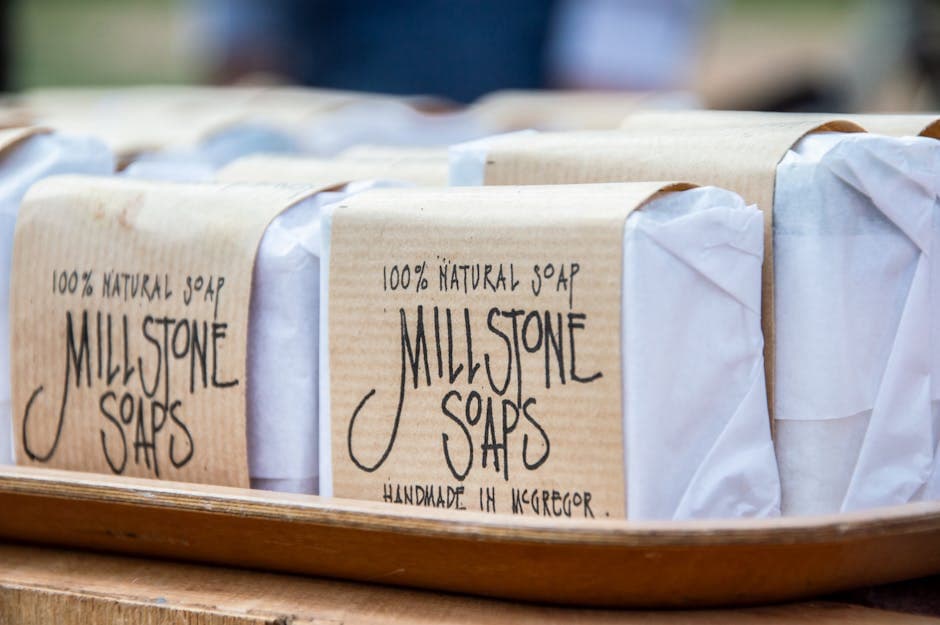
- Kraft paper: Rustic, natural look (use with shrink wrap to protect)
- Clear labels: Modern, lets the soap show through
Include These Optional (But Smart) Elements
- Scent name prominently displayed
- Brief ingredient list (builds trust)
- Your logo
- Website or social media handle
- "Handmade in [City, State]" (customers love local)
- Batch number (helps you track problems)
Label Sizing
Most bars work well with:
- Cigar band: Wraps around the middle of the bar, 1.5-2 inches wide
- Full wrap: Covers most of the bar, 7-8 inches long for standard bars
- Top label: Sits on top of shrink wrap, 2x3 or 3x3 inches
Printing Your Labels
At Home
- Inkjet printer: Good for small batches, but ink can smear with moisture
- Laser printer: Water-resistant toner, excellent for soap labels
- Label stock: Buy waterproof sheets from Amazon
Professional Printing
For larger runs (500+), professional printing is more cost-effective:
- Sticker Mule, Avery WePrint, or Vista Print: Upload your design, get pro-quality labels
- Cost: Typically $0.10-0.30 per label in bulk
Design Tools
- Canva: Free, easy, tons of soap label templates
- Avery Design & Print: Free, formats for their label sheets
- Adobe Illustrator: Professional option for custom work
Supplies for Labeling
- Waterproof Label Sheets (Laser Printer) - Won't smear from moisture
- Cigar Band Soap Labels - Classic wrap-around look
- Shrink Wrap Bags for Soap - Protect labels and bars
- Heat Gun for Shrink Wrap - Quick, even shrinking
Build Your Recipe First
Before you can label your soap, you need a solid recipe. Use our Soaply calculator to build, test, and save recipes with exact oil percentages and lye amounts. Knowing your exact formulation makes writing accurate ingredient lists simple.
Already selling? Check out our guides on how to price handmade soap and how to start a soap business for more on turning your hobby into income.
💬 Frequently Asked Questions
Do I need to list ingredients on handmade soap?
If your product qualifies as "true soap" under FDA guidelines (made by saponification, labeled as soap, no cosmetic claims), you're not legally required to list ingredients. However, most sellers include ingredients voluntarily because customers expect transparency and it builds trust.
What claims can I make on my soap label?
For true soap, stick to describing what's in the product ("Made with olive oil and lavender essential oil") rather than what it does to skin. Avoid claims like "moisturizing," "anti-aging," or "treats acne," which can reclassify your soap as a cosmetic or drug with stricter regulations.
Do I need FDA approval to sell handmade soap?
No. True soap doesn't require FDA approval, registration, or testing before sale. It falls under CPSC jurisdiction, which has minimal requirements. However, if your product is classified as a cosmetic, you must follow FDA labeling rules (though pre-market approval still isn't required for cosmetics).
How do I determine the net weight for my soap label?
Weigh your bars after they've fully cured (4-6 weeks), since bars lose 10-15% of their weight during curing. Weigh several bars from the same batch and use the average or lowest weight. Display as "Net Wt." with both ounces and grams on the front panel.
Can I call my soap "natural" or "organic"?
You can call soap "natural" since there's no legal definition for that term in cosmetics. However, "organic" requires USDA certification. You CAN say "made with organic ingredients" if those specific ingredients are certified organic. Don't use "organic" loosely; it misleads customers and could attract regulatory attention.
Ready to Try It?
Use our free soap calculator to create your perfect recipe with real-time property predictions.
Open Calculator